
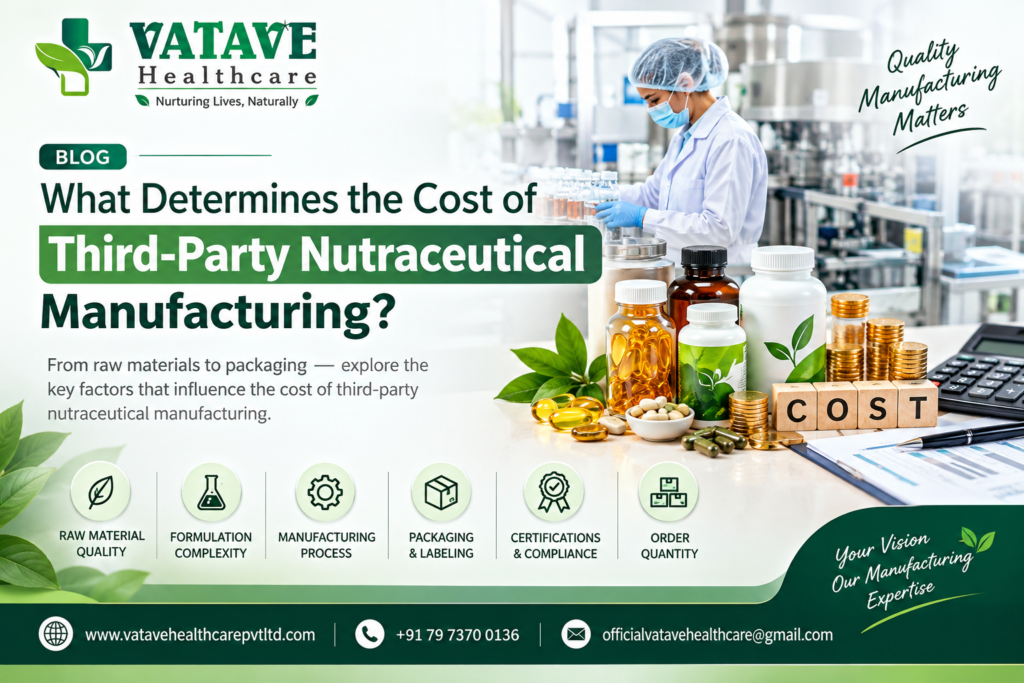
Quick Answer: What Determines the Cost of Third-Party Nutraceutical Manufacturing? The cost is mainly influenced by the formulation, raw materials, dosage form, order quantity, packaging, testing, customization, production process, and logistics. Therefore, the final price can vary from one product and manufacturer to another.
What Determines the Cost of Third-Party Nutraceutical Manufacturing?
What Determines the Cost of Third-Party Nutraceutical Manufacturing? There is no universal price for third-party nutraceutical production. Instead, the final manufacturing quotation is generally prepared according to the product formulation, ingredients, quantity, dosage form, packaging and quality requirements.
For example, a standard vitamin capsule may require a different production setup from a customized gummy, softgel, powder or liquid supplement. Similarly, a product using specialized ingredients may have a higher raw-material cost than one using commonly available ingredients.
Therefore, businesses should request an itemized quotation instead of comparing only the final per-unit price.
In India, nutraceuticals and health supplements are covered by the applicable food-safety framework. The latest requirements should be checked through official FSSAI regulations and notifications before a product is manufactured or marketed. FSSAI Food Safety Regulations
Key Factors That Determine Nutraceutical Manufacturing Cost
When evaluating What Determines the Cost of Third-Party Nutraceutical Manufacturing?, several factors should be considered together. The manufacturing price is rarely based on only the cost of producing one unit.
The main cost factors include:
- Raw materials and active ingredients
- Product formulation
- Dosage form
- Manufacturing process
- Minimum order quantity
- Packaging materials
- Quality testing
- Labelling and artwork
- Product customization
- Storage and transportation
- Documentation and quality requirements
Understanding these factors can help a business prepare a realistic product budget.
1. Raw Materials and Ingredients
Raw materials are one of the most important elements in What Determines the Cost of Third-Party Nutraceutical Manufacturing?
A nutraceutical formula can contain vitamins, minerals, amino acids, botanical extracts, probiotics, enzymes, proteins and other permitted ingredients. However, each ingredient can have a different price depending on its specification, source, quantity and availability.
For example, a formulation containing several common vitamins may have a different raw-material cost from a formulation containing premium botanical extracts or specialized ingredients.
The quantity used per serving also matters. If an expensive ingredient is required at a higher dosage, the cost per finished unit can increase.
2. Product Formulation and Development
Formulation is another important part of What Determines the Cost of Third-Party Nutraceutical Manufacturing?
Some businesses select an existing formulation offered by the manufacturer. Others request modifications or develop a completely customized formula.
Customized development may involve:
- Ingredient selection
- Dosage adjustment
- Flavour development
- Texture improvement
- Ingredient compatibility
- Stability considerations
- Product trials
- Prototype development
Consequently, a customized nutraceutical may require additional development time and resources compared with a standard formulation.
3. Dosage Form and Manufacturing Process
The dosage form can significantly influence manufacturing requirements. Therefore, it is important to mention the dosage form when requesting a quotation.
Common nutraceutical formats include:
| Dosage Form | Examples |
|---|---|
| Tablets | Vitamins and mineral supplements |
| Capsules | Herbal and nutritional formulations |
| Softgels | Oils and fat-soluble nutrients |
| Powders | Protein and nutritional drink mixes |
| Gummies | Vitamins and lifestyle supplements |
| Liquids | Syrups and liquid supplements |
| Effervescent Tablets | Drinkable supplement products |
Each format requires different equipment, processing steps and packaging systems.
For instance, a tablet may require blending, granulation or compression, while a gummy can require a specialized production process. Thus, the dosage form should always be included in a manufacturing brief.
Minimum Order Quantity and Production Volume
One of the frequently discussed factors in What Determines the Cost of Third-Party Nutraceutical Manufacturing? is minimum order quantity, commonly called MOQ.
Manufacturers may establish an MOQ because production requires raw materials, machine setup, packaging materials, labour and quality checks.
A larger production quantity can sometimes distribute certain setup costs across more units. As a result, the per-unit price may change when the order quantity changes.
However, businesses should not automatically select the largest possible quantity. Inventory investment, storage requirements, demand and product shelf life should also be considered.
Before placing an order, ask:
- What is the MOQ?
- Is MOQ calculated per product or per batch?
- Is packaging MOQ different?
- Can different flavours or variants be combined?
- Is a pilot batch available?
These questions can make the quotation easier to understand.
Packaging and Labelling Costs
Packaging is another major consideration when studying What Determines the Cost of Third-Party Nutraceutical Manufacturing?
A product may be packed in bottles, jars, blister packs, pouches, sachets, cartons or other suitable formats. The selected packaging material can influence the total cost.
Packaging expenses may include:
- Bottle or container
- Cap
- Label
- Carton
- Seal
- Printing
- Packaging inserts
- Special finishing
- Shipping cartons
Customized packaging may cost more than standard stock packaging. Furthermore, printed materials may have their own minimum quantities.
Businesses should therefore calculate packaging costs together with manufacturing costs instead of treating packaging as a separate afterthought.
Quality Testing and Laboratory Costs
Quality testing should also be considered when asking What Determines the Cost of Third-Party Nutraceutical Manufacturing?
Depending on the product and applicable requirements, quality checks may involve raw materials, in-process materials and finished products.
Testing requirements can vary according to the ingredients and product category. Possible areas may include identity, composition, microbiological quality and contaminants, where applicable.
Before finalizing a manufacturer, ask:
- Which tests are performed?
- Are tests performed internally?
- Are external laboratories used?
- Is testing included in the quotation?
- What documentation is supplied with the finished batch?
FSSAI provides official regulations and guidance relevant to food businesses, including health supplements and nutraceutical products. Current requirements should be checked before commercial production. FSSAI Official Website
Customization Can Increase the Overall Cost
When discussing What Determines the Cost of Third-Party Nutraceutical Manufacturing?, customization should not be ignored.
A private-label product using an existing formulation can have different development requirements from a completely customized product.
Customization may include:
- New formulation
- Unique flavour
- Special dosage
- Customized packaging
- Special product size
- Brand-specific label
- Different serving format
- Product-specific testing
The more customized the manufacturing requirement becomes, the more carefully the development and production costs should be discussed.
Storage and Transportation Expenses
Manufacturing cost is not always the same as the final delivered cost. Therefore, logistics should also be included when evaluating What Determines the Cost of Third-Party Nutraceutical Manufacturing?
Transportation expenses can depend on:
- Delivery location
- Shipment weight
- Number of cartons
- Product volume
- Transportation method
- Storage requirements
- Number of deliveries
A manufacturer located closer to the business’s warehouse may have different logistics costs from a manufacturer located farther away.
For accurate budgeting, ask whether transportation is included in the quoted price or charged separately.
Documentation and Regulatory Requirements
Documentation is another area that should be discussed before signing a manufacturing agreement.
Depending on the product and arrangement, businesses may need to discuss:
- Applicable licences
- Product specifications
- Raw-material records
- Batch documentation
- Certificates of analysis
- Testing reports
- Packaging information
- Label details
- Complaint-handling procedures
- Product recall procedures
Regulatory requirements should be verified against the latest official sources because requirements can be updated over time.
How to Request an Accurate Manufacturing Quote
If you want to understand What Determines the Cost of Third-Party Nutraceutical Manufacturing?, begin by preparing a detailed product brief.
Include:
- Product name
- Product category
- Dosage form
- Complete formulation
- Ingredients and quantities
- Pack size
- Required quantity
- Packaging type
- Label requirements
- Expected delivery timeline
- Testing requirements
A detailed brief helps manufacturers prepare quotations using the same specifications.
As a result, your comparison becomes more meaningful because one manufacturer is not quoting for a simple stock formula while another is quoting for a highly customized product.
Example of Different Manufacturing Costs
Consider two businesses launching a vitamin capsule.
The first business chooses a standard formulation, standard bottle and a large production quantity. The second business requests customized ingredients, premium packaging, additional development work and a smaller production quantity.
Although both products may be sold as vitamin capsules, their manufacturing costs can be different.
This example shows why What Determines the Cost of Third-Party Nutraceutical Manufacturing? cannot be answered with one fixed price.
How to Compare Manufacturing Quotations
After receiving quotations, create a comparison sheet.
| Cost Factor |
|---|
| Raw materials |
| Formulation |
| Manufacturing |
| Packaging |
| Testing |
| Artwork |
| MOQ |
| Logistics |
| Total estimated cost |
Most importantly, make sure each manufacturer has quoted against the same product specifications.
A lower quotation may appear attractive initially, but it may exclude packaging, testing, transportation or development charges. Therefore, compare the complete cost structure.
Common Mistakes That Increase Product Cost
Businesses sometimes focus too heavily on the manufacturing price per unit. However, several other decisions can increase the final budget.
Common mistakes include:
- Ordering excessive inventory
- Changing the formulation after approval
- Selecting expensive packaging unnecessarily
- Delaying artwork approval
- Not confirming testing requirements
- Ignoring packaging MOQ
- Comparing different formulations
- Failing to clarify transportation charges
- Not confirming payment terms
Planning these details early can make the manufacturing process smoother.
Questions to Ask a Third-Party Nutraceutical Manufacturer
Before placing an order, ask:
- What is the minimum order quantity?
- What is included in the quoted price?
- Are raw materials included?
- Is packaging included?
- Are testing charges included?
- What is the expected production time?
- Can the formulation be customized?
- What quality documents are provided?
- How are failed batches handled?
- Are transportation charges separate?
These questions can help businesses understand the complete commercial arrangement.
Conclusion
What Determines the Cost of Third-Party Nutraceutical Manufacturing? The answer includes raw materials, formulation, dosage form, production quantity, MOQ, packaging, testing, customization, documentation and logistics.
There is no single manufacturing price that applies to every nutraceutical product. Instead, the cost should be calculated according to the exact product specification and manufacturing requirements.
Therefore, businesses should prepare a detailed product brief and request itemized quotations from potential manufacturing partners. The latest applicable FSSAI requirements should also be verified before production and marketing.
If you are planning to launch a nutraceutical product, compare the complete cost rather than only the per-unit manufacturing rate. A clear quotation, defined specifications and proper documentation can help create a more transparent manufacturing process.
FAQs
What Determines the Cost of Third-Party Nutraceutical Manufacturing?
The cost is affected by ingredients, formulation, dosage form, MOQ, production quantity, packaging, testing, customization and logistics.
Does MOQ affect nutraceutical manufacturing costs?
Yes. MOQ can influence production planning, raw-material purchasing, packaging requirements and the final per-unit price.
Does customized formulation cost more?
It can. Customized formulations may require development, trials, ingredient evaluation and additional testing compared with standard formulations.
Does packaging affect the manufacturing price?
Yes. Bottles, labels, cartons, pouches, blister packs and customized packaging can all influence the final product cost.
What should I provide when requesting a manufacturing quotation?
Provide the formulation, dosage form, ingredients, quantity, pack size, packaging requirements, testing expectations and delivery timeline.