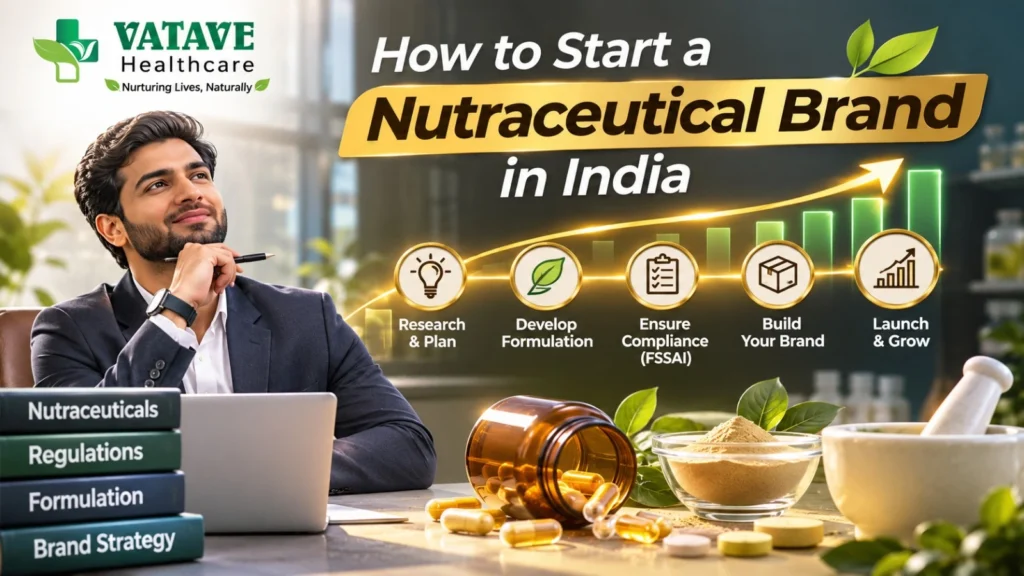
How to start a nutraceutical brand in India comes down to six actions: choose a product niche, register a business, obtain an FSSAI licence, finalise compliant formulations, partner with a licensed manufacturer, and register a trademark before selling. Most new brands use a third-party nutraceutical manufacturer instead of building a plant, which lowers upfront investment and shortens the time to launch. Every product must follow FSSAI rules on ingredients, labelling, and health claims. The overall timeline depends mainly on how quickly licences and any product approvals arrive.
India’s nutraceutical market was valued at about $29 to $30 billion in 2024 and is projected to reach $55 to $57 billion by 2030, according to a June 2026 report by CareEdge Ratings. That growth of roughly 10 to 11 percent a year is attracting founders, doctors, pharmacists, and fitness entrepreneurs who want to start a nutraceutical brand in India under their own label. The problem is that the path is not obvious. Licensing, ingredient rules, labelling, and manufacturer selection all decide whether a brand launches on schedule or stalls for months.
This guide explains the full process from the first market decision to the first sale. It covers business registration, FSSAI compliance, formulation, manufacturing partners, trademarks, and sales channels. A summary table appears early, and the FAQ at the end answers the questions founders ask most often.
What a Nutraceutical Brand Is and Who Regulates It
A nutraceutical brand sells products such as vitamins, minerals, protein powders, herbal extracts, probiotics, and joint health formulations that support health beyond basic nutrition. In India, the Food Safety and Standards Authority of India (FSSAI) regulates most of these products as health supplements and nutraceuticals. The governing rules are the Food Safety and Standards (Health Supplements, Nutraceuticals, Food for Special Dietary Use, Food for Special Medical Purpose, Functional Food and Novel Food) Regulations, 2022. A nutraceutical company in India either manufactures its own products or markets products made by a licensed partner.
Ayurvedic and traditional formulations follow a separate path under the Ministry of AYUSH, with different licensing. A founder must decide early which category a product belongs to, because the licence, label, and permitted claims differ. This guide covers FSSAI-regulated products.
How to Start a Nutraceutical Brand in India Step by Step
The process follows a fixed order, and skipping a stage usually causes delays later. The table below summarises each stage before the detailed explanation.
Action
- Research the market and choose a niche
- Register the business and obtain GST
- Apply for an FSSAI licence
- Confirm formulation and ingredient compliance
- Select a manufacturing partner
- Register the trademark and design the label
- Set up sales channels and launch
Main Output
- Product shortlist
- Legal entity and GSTIN
- FSSAI licence number
- Approved formula
- Production agreement
- Registered brand and compliant label
- First commercial batch
Step 1: Research the Market and Choose a Niche
Start with demand, not with a formula. Categories such as immunity, joint health, women’s health, sports nutrition, gut health, and sleep each carry different competition levels and buyer expectations. Review marketplace listings, search volume, and the price range of the best nutraceutical brands in India to find a gap.
A narrow niche, such as joint support for adults over 40, is easier to rank for and market than a general multivitamin. Choose two or three products for the first launch, not twenty. Recommended approach: a narrow niche with a small product range.
Step 2: Register the Business and Obtain GST
Select a structure: sole proprietorship, partnership, LLP, or private limited company. A private limited company is the most common choice for a nutraceutical company in India that plans to raise investment or sell across states. The basic requirements are company registration with the Ministry of Corporate Affairs, a PAN, a current bank account, and GST registration.
A chartered accountant or company secretary can confirm the right structure for the ownership and funding plan.
Step 3: Apply for an FSSAI Licence
Every food business operator in India, including nutraceutical brands, needs an FSSAI registration or licence. The category depends on turnover and the nature of the business, and the thresholds sit in the FSSAI licensing regulations. Applications go through the Food Licensing and Registration System, known as FoSCoS.
A brand that outsources production still needs its own FSSAI licence as a marketer, while the manufacturer holds a separate manufacturing licence. A valid FSSAI licence for nutraceuticals is also a basic requirement for listing on Amazon India and Flipkart.
Step 4: Confirm Formulation and Ingredient Compliance
FSSAI permits listed ingredients, vitamins, minerals, amino acids, and botanicals within set limits. An ingredient outside the schedules, or a dose above the permitted level, requires product approval from FSSAI before sale. Popular formulations such as glucosamine, chondroitin, and MSM combinations, omega-3 capsules, and probiotics must be checked against the current schedules.
A qualified food technologist or the manufacturer’s regulatory team can verify the formula before production begins. Changing a formula after packaging is printed is expensive, so this check comes first.
Step 5: Select a Manufacturing Partner
A nutraceutical company in India that builds its own plant needs land, machinery, good manufacturing practice compliance, and trained staff. For this reason, most new brands choose private label or contract manufacturing. The brand owns the formula, name, and label, while the partner handles production.
Check the following before signing an agreement:
- A valid FSSAI manufacturing licence
- Good manufacturing practice and food safety certifications
- In-house or NABL-accredited laboratory testing for every batch
- Minimum order quantity and production lead time
- Written terms on formula ownership and confidentiality
Request samples and visit the facility if possible. Price alone is a poor basis for choosing a partner, because inconsistent quality damages reviews and repeat purchases.
Step 6: Register the Trademark and Design the Label
File a trademark application with the Trade Marks Registry, usually in Class 5 for dietary supplements, before investing in packaging. Search existing marks first to avoid conflicts. The label must follow FSSAI labelling rules and typically includes:
- Product name, brand name, and ingredient list with quantity per serving
- Nutritional information and the vegetarian or non-vegetarian logo
- FSSAI logo and licence number
- Batch number, manufacturing date, and expiry date
- Manufacturer and marketer details
- Required statements, such as a note that the product is not for medicinal use
Health claims must be supported by evidence and follow FSSAI advertising and claims rules. Words such as cure or treat must not appear on the label or in advertising.
Step 7: Set Up Sales Channels and Launch
Most new brands launch on a direct-to-consumer website and one or two marketplaces, then add pharmacies and distributors as volume grows. Marketplaces ask for FSSAI details and clear images of the compliant label. Order small first batches to protect cash flow and to test shelf life, reviews, and repeat purchase before scaling.
What the Best Nutraceutical Brands in India Have in Common
The best nutraceutical brands in India tend to follow a few habits that new founders can copy. They publish full ingredient quantities on the label, test every batch at an accredited laboratory, and keep health claims within FSSAI rules. They also concentrate on a few hero products and build repeat purchase through reviews and subscriptions instead of relying on discounts.
Trust is the common thread. A buyer cannot judge a supplement by looking at it, so transparent labelling, clear batch testing, and honest claims carry more weight than packaging alone.
Costs and Timeline for a New Nutraceutical Brand
Costs depend on the number of products, the manufacturer’s minimum order quantity, packaging, and marketing spend. The main cost heads are business registration, FSSAI licensing, formulation and lab testing, trademark filing, packaging design and printing, the first production batch, and marketing. Written quotes from at least three manufacturers give the most realistic budget.
Timelines vary because licence processing and any product approval depend on the authority. Founders should plan a buffer between licence application and the first batch, since printing labels before the licence number is issued leads to wasted stock.
Common Mistakes to Avoid When Starting a Nutraceutical Business in India
The most frequent mistake is launching before the FSSAI licence and label are final. Other errors include using unlisted ingredients without approval, making disease claims, and choosing a third-party nutraceutical manufacturer on price alone. Each of these can lead to relabelling, product removal, or penalties.
Brands also lose time by skipping trademark checks and launching too many products at once. A tight range, a clean label, and a reliable manufacturing partner give a new brand the strongest start.
Frequently Asked Questions
The answers below address the questions founders ask most often when planning a nutraceutical brand. Each answer applies to FSSAI-regulated supplements.
How Much Does It Cost to Start a Nutraceutical Brand in India?
There is no fixed figure, because cost depends on the number of products, the manufacturer minimum order quantity, packaging, and marketing spend. A brand that uses third-party manufacturing and launches two or three products needs far less capital than one that builds a plant. The main cost heads are registration, FSSAI licensing, lab testing, trademark filing, packaging, the first batch, and marketing. Request written quotes from at least three manufacturers to estimate a realistic budget.
Is an FSSAI Licence Mandatory for Selling Nutraceuticals in India?
Yes. Any business that sells food products, including health supplements and nutraceuticals, needs an FSSAI registration or licence. The category depends on turnover and business type. A brand that outsources production still needs its own licence as a marketer, and the manufacturer needs a separate manufacturing licence. Selling without a valid licence can lead to penalties and removal from online marketplaces.
Can I Launch a Supplement Brand in India Without a Factory?
Yes. Third-party or contract manufacturing lets a brand sell under its own name without owning a plant. The brand owns the formula, label, and trademark, while a licensed manufacturer produces each batch. The manufacturer should hold a valid FSSAI manufacturing licence and follow good manufacturing practices. A written agreement should cover formula ownership, confidentiality, quality checks, and minimum order quantity.
Do Nutraceutical Products Need FSSAI Approval Before Sale?
It depends on the ingredients. Products that use ingredients and doses listed in the FSSAI schedules can generally be sold under a valid licence without separate product approval. A formula that includes an unlisted ingredient or a dose above the permitted limit requires approval from FSSAI first. A food technologist or the manufacturer’s regulatory team can check the formula against current schedules before production starts.
Which Nutraceutical Products Sell Best in India?
Demand varies by audience, but common categories include multivitamins, protein powders, immunity products, omega-3, probiotics, and joint health supplements. Mintel reports that 24 percent of Indian respondents used vitamins, minerals, or supplements in the past six months, which points to room for category growth. Marketplace listings and keyword data help confirm demand for a specific niche before a founder commits to a formula.